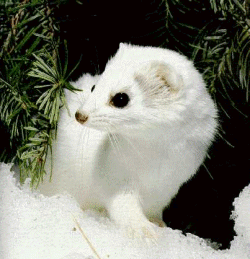
Stoats
In Redwall
- Alignment: Evil
- Appearance: Stoats look like stoats in our world except bipedal and
clothed.
- Diet: Stoats eat whatever they can get their paws on, which isn't
usually much, as they usually get poor rations in the armies where they're
fairly low-ranked.
- Typical Personality: Stoats are some of the stupidest of
vermin. Most stoats in the Redwall series are bumbling idiots who are
often low in rank in hordes. Many times they defect. They are
often very cowardly and whine a lot. Outside of hordes, many stoats
are bandits and thieves. Oftentimes they use a sort of
"street-slang" type of accent, and are many times described as
speaking in a whining tone. However, as with any species, there are
exceptions: Badrang was a stoat, yet he spoke without an accent and was
quite intelligent.
Outside Redwall
- Classification: Species: Mustela erminea
- Other Names: Stoat, ermine
- Appearance: Stoats look like weasels or ferrets, with a long
slender body, but with shorter legs. Their medium-short tail, 95-140mm
in length, always has a black tip, and their fur is anywhere between
ginger-red and reddish-brown. Some stoats turn white or mostly white
in winter. Males are typically 275-312 mm in length and weigh around
200-445g, while females are normally 242-292 mm long and weigh 140-280g.
- Life Span: In the wild, females live for about two years and males
usually don't live that long.
- Diet: Stoats feed on mostly small mammals and rodents, like
rabbits, voles, and mice. In addition to this, they also eat birds,
eggs, fruit and even earthworms when food is scarce.
- Habitat: Stoats don't like to be in the open, so they take over the
dens of former prey and hunt ditches, hedgerows and walls or through meadows
and marshes.
- Typical Personality: Stoats are territorial and solitary, more
aggressive than the weasel.
- Habits: Stoats hunt in a zigzag pattern, and females hunt in
tunnels more than males do. They may travel up to 10 or 15 km in one
night.
- Life Cycle: Between 6 and 12 kits are born per litter every spring
between April and May, and they stay with their mother until they are 12
weeks old. The mother only has one litter a year.
- Sites for Further Research: